
Learning from Right Mentors
Updated: Feb 18, 2023
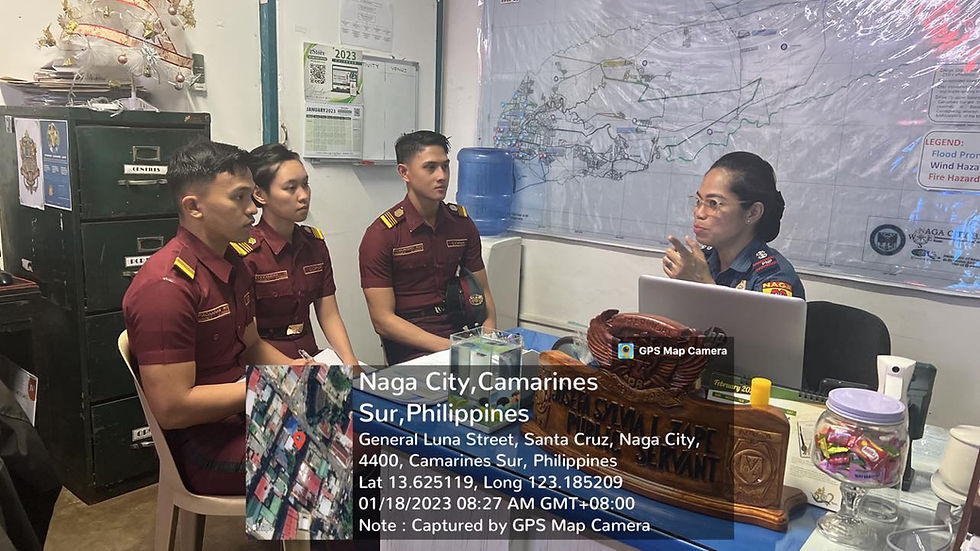
City Police Office's Operation Section with the Cadets. She shared her professional experiences, obstacles, and methods for completing all of the responsibilities assigned to her department. Her primary goal in the conversation is to provide tips for managing the people under her control and insights to boost our leadership abilities and self-assurance.
The Philippine National Police (PNP) faces myriad challenges, spanning governance, corruption, and national security threats. Hence, securing a solid leadership pipeline equipped to meet these challenges and strengthen policing effectiveness and overall security sector reforms is crucial. This study aims to map out some main factors that both build or erode essential leadership qualities and performance in the PNP.
Using quantitative and qualitative methods and leveraging a comprehensive dataset of police officers in the National Capital Region (NCR), the study examines four main factors: personality traits, organizational culture, demographic profile, and professional history. The results show that personality facets of openness, agreeableness, and neuroticism, as well as several transfers, areas of assignment, training on managerial skills, age, and education level, are all factors for good performance for officers in the PNP National Capital Region Police Office. These findings emphasize the importance of training and mentoring components in preparing young officers and recruits for the rigors of service. It also underscores the need for a deeper analysis of recruitment and selection policies to ensure that the PNP successfully attracts the strongest candidates with exemplary leadership characteristics and building blocks for service.[1]
It is a beautiful joy and privilege to learn from a woman officer in charge of a division or department predominately made up of male cops. It opened our eyes to the fact that there are Institutions for gender equality and that women may also accomplish their goals. The operation section's sections on internal security, public safety, statistics and research, law enforcement, and special operations are clarified and illustrated. It underlines how well she comprehends its boundaries and the offenses for which her components will be used. In the event of unneeded events, protests, and other pertinent concerns that develop in society, they are also involved in maintaining peace and security by counter, reactive, and proactive tactics. The country is on the correct route to producing police officers for future generations by inspiring future leaders of our country.
Leadership is a crucial aspect of organizational success, and influential leaders are those who are not content with meeting expectations but strive to surpass them instead. By setting high goals and working tirelessly to achieve them, leaders can inspire their teams to achieve great things. Gender should not hinder leadership, and the experience and knowledge of female leaders in male-dominated fields can provide valuable insights for future male leaders. As a future male officer, I recognize the challenges of leading an organization with a female officer who can manage a department. It inspires me to do my job well; the rationale is that a female officer can do her task, and a male officer can do his job better than a female officer. Effective leadership requires a willingness to learn from others, regardless of gender or background, and incorporate those insights into one's leadership style.
The conversation with the officer in charge of the Operation Section provided valuable insights into leadership and management in the PNP. It highlighted the importance of building a solid leadership pipeline to meet the organization's challenges, including governance, corruption, and national security threats. The fact that a woman officer is leading a division made up predominantly of male cops showed us that gender equality is possible in the PNP. The officer's expertise in the different sections of the Operation Section illustrated the importance of understanding the boundaries and responsibilities of each component. It also emphasized the area's role in maintaining peace and security through reactive, proactive, and counter-tactics. Overall, the conversation inspired us as future leaders to take on the challenges facing the PNP and work toward building a better and safer future for our country.
#MASIDTALAK2023 #PNPA #MKKequalsK #lifeisbeautiful #KaligtasanNiyoSagotKo #PNPKakampiNyo #TulongTulongTayo
[1] Mendoza, R.U. et al. (2020) Diagnosing factors behind officers' performance in the Philippine National Police, Taylor & Francis. Available at: https://www.tandfonline.com/doi/abs/10.1080/15614263.2020.1795860 (Accessed: January 25, 2023).



Comments