
Naga City Police Office, Police Station 1 OPERATION SECTION
Updated: Feb 20, 2023
CHECKPOINT
Let's first review a few fundamental terminologies before we get into the details. The PNP defines a checkpoint as "a place where the military or police check vehicular or pedestrian traffic to enforce circulation control measures and other laws, orders, and regulations with only a brief detention of travelers during which the vehicle's occupants are required to answer a brief question or two."
This will typically consist of a team leader, spotter, spokesperson, investigation sub-team, search/ arresting sub-team, security sub-team, and blocking/pursuing sub-team. This kind of checkpoint will also come with a collapsible signage with markings: "Stop, Police Checkpoint", also indicating the name of the concerned police office/unit conducting the operations.[1]
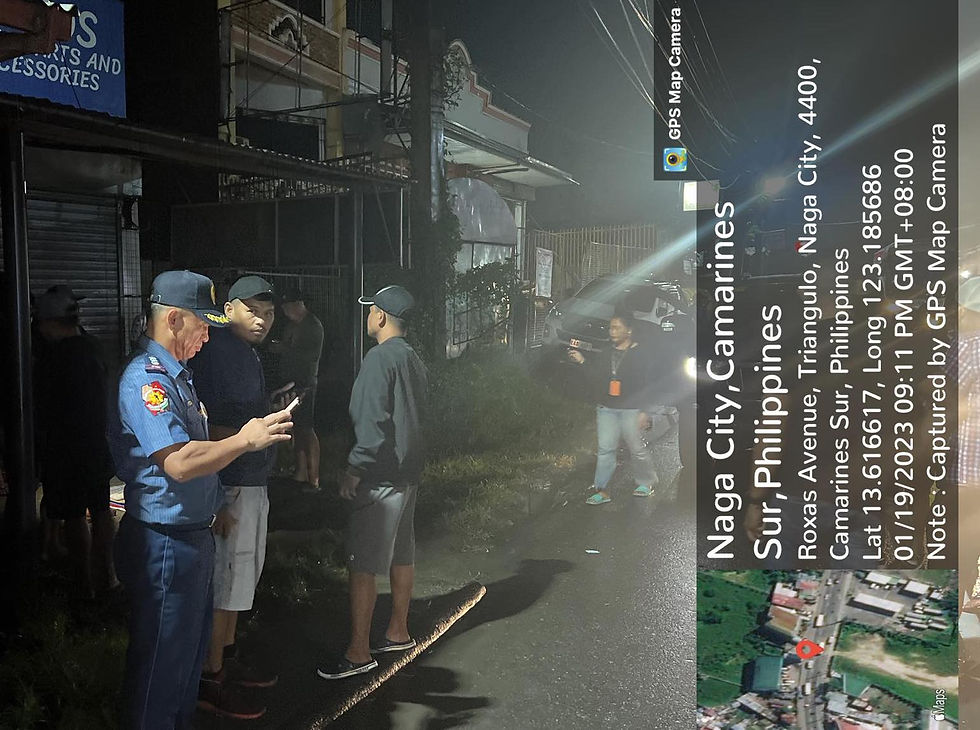
To reprimand and issue tickets to drivers who do not possess driver's licenses, Naga City Police Station used Police Station 1 to conduct a simultaneous checkpoint in the regions it patrols. To reduce the number of fines that the violators must pay to the government, PNP officers solely used municipal citations in the execution of the activity, as mentioned earlier. It serves only to warn them and demand that they have the correct documentation to operate a vehicle on public roads. It is preferable to cite this infraction at the PNP level rather than risk being warned or detained by agents from the Land Transportation Office and paying thousands of pesos in fines. The Operation was also expanded to issue citations to drivers disregarding the PNP, and the local government's proclaimed traffic regulations.
OPLAN BAKAL
Oplan Bakal is a police operation in an establishment, usually a bar or nightclub, where police officers enter the place unannounced and conduct a search for firearms that may have customers or guests. It is a surprise search, so gun-wielding guests or customers can be caught red-handed. As we all know, and as clearly posted at the entrances of bars and clubs, firearms are not allowed inside the establishments. Unknown to many, Oplan Bakal is welcome to club and bar management and owners who give police prior approval without knowing when the Operation will be conducted because Oplan Bakal helps ensure the safety of most customers and the club personnel themselves. In fact, on many occasions, the club or bar owner discreetly requests an operation on his premises, especially if he is aware that a customer or two bring a gun inside the premises. In conducting Oplan Bakal, the police request guests to stand up so that they can see if a firearm is tucked in their waists or if anything is suspiciously bulging underneath their clothes.[2]

In the absence of the Team Leader, a Police Commissioned Officer, this Operation of the PNP organization should be monitored and directed by a Senior Non-Commissioned Officer. Being familiar with this Operation is essential for any aspiring new officer, as being a Team Leader of a patrol unit was our first career goal following graduation. Numerous police obligations, including maintaining police visibility, finding lost weapons, and providing safety to the general public and businesses, may be carried out during this Operation. This effort will help to build public trust and create a tranquil, crime-free environment. Due to assurances of their protection and security, investors and other stakeholders will open up their operations and activities in your area. Later, we can ask for their support for additional police action, particularly in community outreach programs, thanks to the service, protection, and security we offer to Investors and other stakeholders.
FUNCTION AND RESPONSIBILITIES OF THE CITY OPERATION SECTION
MISSION
Assists the Regional Director in exercising command, control, direction, coordination, and supervision of the vast expanse of police operational activities, especially in crime prevention, law enforcement, internal security, and delivery of public safety services, including employment and deployment of the PNP.
FUNCTIONS
1. Plans, directs, control, coordinates, and supervises PNP operations and integrates support activities
2. Evaluates and prepare mobilization, demobilization, assignment and location, and employment/deployment of units in coordination with other Directorial Staff
3. Prepares, coordinates, and issues operational plans, orders, and directives following the Chief, PNP's policies and guidelines
4. Maintains active liaisoning with other Operating Units of the military and other law enforcement agencies
5. Maintains close supervision, direction, control, and coordination of operational activities of all operating units in Naga City
6. Heads the National Law Enforcement Coordinating Committee Secretariat.
LAW ENFORCEMENT SECTION (LES)
1. Take appropriate action on organized crimes, non-organized crimes, special laws, and the Revised Penal Code.
2. Formulate policies, directives, and LOIs about law enforcement, monitor its implementation, and submit a report to the SILG thru the Chief, PNP, as necessary.
3. Prepare the law enforcement portion of the annual PNP Operating Program and Budget Guidance
4. Prepare operational plans on anti-criminality operations to include crime prevention and crime suppression
5. Prepare law enforcement-related briefings and special reports as necessary
6. Responsible for the strict compliance to the provisions of PD 1866 as amended by RA 8294 of companies applying for permits to operate, import, and export firearms and explosives;
7. Responsible for all matters about NALECC/POC/ NAPOLCOM Law Enforcement Pillars
INTERNAL SECURITY OPERATION SECTION (ISO)
Takes charge of all matters about counter-insurgency, Communist Terrorist Movement (CTM), Muslim Secessionist Groups (MSG) and other threat groups.
ISO FUNCTIONS
1. Takes appropriate staff action on ISO matters.
2. Coordinates and monitors operations against CTs, SPSGs, local and foreign terrorist groups, and destabilization threat groups.
3. Formulates policies and directives on internal security and monitors their implementation.
4. Prepares the internal security operation portion of the annual PNP Operating Program and Budget Guidance and the Program Review and Analysis.
5. Prepares operational and tactical plans on internal security about the PNP Master
ISO OTHER FUNCTIONS
1. Exercises staff action on the deployment of SAF Exercises staff action on the other NOSUs under the DO functional grouping.
2. Initiates/directs the PROs and NOSUs for action based on reports as contained in the Daily Intelligence Brief
3. Consolidates the disposition and Location of PROs and their line units.
SPECIAL OPERATION SECTION (SOS)
Concerned with security coverage of notable national and international events and civil disturbance management, including security to dignitaries and prominent personalities.
STATISTICS AND REPORTING SECTION (SRS)
Databank of operational accomplishments of the whole PNP Evaluates the performance of PNP offices and units based on the results of their operations Prepares periodic operational accomplishment reports.
SRS FUNCTIONS
1. Gather, collate & store operations accomplishments of the different PNP units/offices
2. Collate all accomplishments PNP-wide & prepare quarterly, semi-annual & annual PNP Accomplishment Reports
3. Analyze & assess the performance of PNP subordinate offices/units based on the results of operations
4. Prepare ODO-related briefings & special reports as necessary Public Safety Section (PSS) To assist the TDO on matters about public safety, specifically on: Crime prevention ㅇ COPS IACPSP o Critical Infrastructure's Security O Disaster Management Task Force Turista O AGI-ORSITE o Other related activities
PSS FUNCTIONS
1. Take appropriate action on matters about crime prevention, disaster management, security and safety of critical infrastructures, and COPS
2. Formulate policies and directives
3. Prepare operational and tactical plans
4. Liaison with other Operating Units of the military and other law enforcement agencies
CITY TACTICAL OPERATIONS CENTER (CTOC)
1. Assists the Regional Command Group and the Directorial Staff in coordinating, integrating, and supervising PNP operational activities
2. Dispatches communications and receive reports from field units about operations and related matters
3. Establishes liaison with the AFP for the successful conduct of current or contemplated PNP operations
INDEX CRIMES are crimes considered severe and occurring with sufficient frequency and regularity that they are considered an index to the crime situation in a given area (i.e. murder, homicide, physical injury, rape, robbery, theft, and carnapping). NON-INDEX CRIMES are crimes in violation of special laws. [3]
Robberies and thefts are the most frequent crimes in Naga City; they happen every month and become more frequent when pilgrims visit Pilgrim City for festivals and religious events. According to the Crime Information Reporting and Analysis System, or CIRAS, two of Naga City's most notorious theft and robbery gangs are the Salisi Gang and the Akyat-Bahay Gang. It is considered a first-class metropolis where communist-terrorist groups are more often detected through demonstrations held in the city's freedom parks and occasionally in public spaces than through ambush operations.
BEST PRACTICES IN COMPLYING WITH THE UPER
The UPER rating of Operations in NOVEMBER 2022 demonstrates the conduct of crime prevention and control, routine execution of the Patrol plan, Foot patrol, and mobile patrol; they were so busy in November that they exceeded the target numbers, particularly in executing checkpoints. Oplan Bakal's behavior is consistent, and I saw it when we were assigned to NCPS1. Additionally, they examine the operations of the police stations and the employees. With the aim of at least one regular meeting held each month per police station and four as their number of accomplishments, Conducting Enhance Managing Police Operations was also accomplished.
According to PLTCOL JOSEFA SLYVIA ZAPE, Chief of the Operations Section, their issue with complying with UPER is that of the successes against criminal gangs because there are currently no known crime groups in the area. With a target of 15 minutes, the response time has improved dramatically. For November, 26 calls were received and handled with an average response time of 2.50.
In November, they advised ten people who owned firearms but had expired licenses to do so or voluntarily turn them in for safekeeping. Since they achieved 0 to practically all of its parameters, ISO Campaign Plans have been notably low, and this area is now referred to as the "white area." Additionally, there have been no reported bombing incidents. The construction of tourist support desks has completed the implementation of the Tourist Police Unit. However, no reports of crimes involving tourists have been made for November. In addition, they manage security operations and VIP security for local, national, and worldwide events.
They often practice camp defense simulations and have upgraded camp defense. They carry out simulation exercises once a month, according to PLTCOL Zape. Maps showing disaster-prone locations and maps of the criminal situation are also available. Inter-Agency Cooperation, Special Impact Projects, and Innovations are also included. Most importantly, they always deliver their reports on schedule and with accurate data.
SECURITY PLANNING AND CONTINGENCY PLANNING
Our police personnel is always subject to the public's watchful eyes as law enforcers; they scrutinize every action conducted in detail for mistakes that may have been made. A threat to the stations might also be posed by criminals who belong to infamous syndicates, CTG members, and highly organized criminal groups. It has happened frequently that these organizations have attacked police stations; thus, every action we take must be carefully thought out. Coordinating appropriate and quick responses in emergencies is only possible with planning and making backup plans. The worst-case situation occurs when we fail to comprehend that it could happen to us.
Let me now introduce the terms "red teaming," "simulation exercises," and "communication exercises" to you. Red teaming is done to assess vulnerabilities in the security strategy and offer remedies. Camp defense simulation exercises are done to increase the operational readiness of PNP personnel and capabilities.
For familiarization and capability building of the relevant units and agencies, walk-through activities, dry runs, and contingency planning are being conducted at the selected engagement zones. If difficulties, issues, or misunderstandings arise while carrying out these walk-through exercises, they will be acknowledged and dealt. All of them are done once a month at NCPO in cooperation with NCPS1 to make the real contingency plan faultless.

Shown is the Naga City Police Station 1 Camp Defense Plan. "Coordination is key to the program's success, and it involves role-playing disaster and security scenarios to identify what needs to be corrected easily. The said exercises resemble real-life disaster situations, which will happen in real-time to let the participants use various resources to operate- both human and material. "In the line of duty, everybody (police) should know what to do because lives are at risk if we are unprepared" [4]
PROFESSIONALIZATION OF PERSONNEL IN POLICE OPERATION
Section 1 Article III of the 1987 Philippine Constitution states that no person shall be deprived of life, liberty, or property without due process of law, nor shall any person be denied the equal protection of the rules.[5]
This so-called "due process of law" is so delicate that even minor anomalies might damage a criminal or offender's fundamental human rights. The organization mandates that police officers take seminars and skill-development courses to shield them from accusations of power abuse and ineptitude. The PNP uniformed officers are expected to complete mandatory courses or training to broaden their Knowledge for better work performance and career growth. As police officers get ready to take on the duties of a higher level, they also serve as regular training that helps to update and improve their understanding of police affairs. Public safety training is compulsory for all PCOs and PNCOs.
The Coverage of the Examination for Police Commissioned Officer is the following:
a. Personnel Decorum under PNP Ethical Doctrine Manual;
b. Customs and Tradition under PNP Ethical Doctrine Manual;
c. Drills and Ceremonies under PNP Ethical Doctrine Manual;
d. Revised Police Operational Procedures;
e. CMC NLE 2022;
f. CIMOP (for PSOSEC) under PNP MC 2020-081; and
g. CSW (for PSOSEC & PSOAC) under PNP MC 2014-059.
The Coverage of Examination for Police Non-Commissioned Officers are the following:
a. General Knowledge;
b. Personnel Policies and other Human Resource Actions;
c. Intelligence and Investigation
d. Revised Police Operational Procedures; and
e. CMC NLE 2022.[6]
SIGNIFICANCE OF PEACE AND ORDER PUBLIC SAFETY PLAN (POPS-P) IN SUSTAINING THE PPAs OF THE STATION
To clearly understand the goal we want to attain at the end of the year, we must have a solid plan, programs, and activities, or POPS-P. At NCPO, they use POPS-P to track how well they are accomplishing their goals and encourage staff members and citizens to actively participate in advancing peace and development. By determining the general characteristics and traits of the area of responsibility, POPS-P enabled us to assess the public safety situation. To analyze data and give the community better crime prevention strategies, responses, and processes, the state of crime and disorder over the last three years will be considered. The alleged Activity Matrix is another.

With the help of POPS-P, the activities are steered away from several unconnected activities and are guaranteed to impact the realization of peace and development. They use this with the Finance department to calculate the anticipated PPSA costs for the entire year. The Unit Performance Evaluation Rating and Report Forms 1 and 2 will be used to track these actions.

RECOMMENDATION OF CREATIVE MEASURES TO SUSTAIN OR CHANGE FOR FURTHER IMPROVEMENT
The LGU is meant to support PNP monetarily and, if necessary, by providing the essentials needed for the many operations that the PNP conducts day and night, in all weather conditions, to fulfill its commitment to "serve and protect" the community. This expectation, however, never came to pass in NCPS1 due to the LGU's lack of financial support for the PNP activities. Because future skill development and educational support are not financially supported, it has become challenging for those who want to pursue specialized training to get sponsors or save money for school. Each of the seven distinct PNP operations requires a specific budget, which neither the higher headquarters nor the LGU can sufficiently provide. Don't you, as the head of the community, think it is well worth it when the money is used for the people's security and protection?
The following are the 7 Categories of Police Operations:
PATROL OPERATIONS are the foundation of police work and the most fundamental police duty.
LAW ENFORCEMENT OPERATIONS- This include serving an arrest warrant, carrying out a search warrant, enforcing the Chiefs of Police's visitation rights, and doing other anti-criminality operations.
INTERNAL SECURITY OPERATIONS- Include actions to guarantee internal security, such as counterterrorism operations and equivalent actions against other danger groups.
PUBLIC SAFETY OPERATIONS- Include critical event management processes, search, rescue, and retrieval operations, hostage situations, civil disturbances management, health risks, and other operations that advance public safety.
SPECIAL POLICE OPERATIONS- Include the Operation of high-risk checkpoints and roadblocks, police assistance in carrying out court and other quasi-judicial bodies' orders, security at significant events, aircraft hijacking operations, visits to, boardings of, searches of, and seizures of marine vessels, as well as similar police operations carried out by police units with specialized training on the particularity of the mission or purpose.
INVESTIGATION OPERATIONS- Include any scene of the crime (SOCO), administrative inquiry, or other investigative activity required to gather facts and circumstances to file a criminal or administrative case.
POLICE COMMUNITY RELATIONS- Include three interrelated components, namely community affairs and development, public information, and information development operations to increase collaboration and ties with the community to achieve its objective.
The PNP comprises police officers in the Philippines and is responsible for ensuring peace and order, enforcing the law, and protecting the people. To maintain public safety, the organization carries out various operations, including checkpoints, Oplan Bakal, and internal security operations. The checkpoint is where the police or military check vehicles and pedestrians and briefly detain them to enforce traffic and other regulations. At the same time, Oplan Bakal is a police operation in bars or nightclubs to search for firearms. In addition, the PNP has several sections, such as the City Operation Section, the Law Enforcement Section, and the Internal Security Operation Section, which have different responsibilities, such as planning and directing operations, monitoring crime prevention and law enforcement, formulating policies, and coordinating with other law enforcement agencies.
[1] Deriquito, J. (2022) Things to do and not to do at a checkpoint, AutoDeal. AutoDeal.com.ph. Available at: https://www.autodeal.com.ph/articles/car-features/things-do-and-not-do-checkpoint (Accessed: February 6, 2023).
[2] Eleazar, P.G.L.T. (2017) The case for 'Oplan Bakal', RAPPLER. Available at: https://www.rappler.com/voices/imho/182561-case-oplan-bakal-firearms-qcpd/ (Accessed: February 10, 2023).




Comments